Tuesday, April 21, 2020

EmmDev 2020-04-21 [Perspective: God, Faith and Covid19] Clear thinking#1 - Who's to blame?


Clear thinking#1 - Who's to blame?

I'm a very aware that many of us in lockdown are starting to feel the strain and so I've battled with whether to focus on giving you some encouragement or to address some of the theological issues that have emerged. In the end I've decided to do a bit of both...

For this week I want to come back to some of the fuzzy thinking we have around tragedy and just try do some clear thinking on a couple of these issues but at the end of each devotion I'll include an inspirational passage you can reflect on...

For today's thoughts I've borrowed abundantly from a message preached by my friend Francois Mulder at the NG Kerk in Blanco, George.

Now there were some present at that time who told Jesus about the Galileans whose blood Pilate had mixed with their sacrifices. 2 Jesus answered, "Do you think that these Galileans were worse sinners than all the other Galileans because they suffered this way? 3 I tell you, no! But unless you repent, you too will all perish. 4 Or those eighteen who died when the tower in Siloam fell on them--do you think they were more guilty than all the others living in Jerusalem? 5 I tell you, no! But unless you repent, you too will all perish."                    (Luke13:1-5)

The issue for today is our constant need to find something or someone to blame when horrible things happen. People were talking to Jesus about two tragedies that had been "headline news":
  • A senseless act of violence perpetrated by Pilate's soldiers who killed some worshippers while they were making sacrifices in worship.
  • A disaster in which 18 people were killed when a tower collapsed.
They were asking:
- "Whose fault is this?"
- "Were these people more sinful than others?"
- "Had they stepped out from under God's protective umbrella?"
- "Is this God's judgement on them?"

This is very typical of our human nature. Someone must be to blame and almost without fail the erroneous conclusion is that these are His actions and they are punitive in nature.

Jesus goes right to the heart of the matter:
- Stop trying to be "Judge and Jury" over the lives of others.
- God doesn't push towers onto people to punish them.
- Final judgement is coming.
- You have to face God yourself one day
- The real stakes are not physical death but spiritual death (perishing).

Our newspapers, fireside chats, "intellectual" debates all hinge around "solving" the problem of pain. We think that if we can explain it, we can compartmentalize and contain it. But all of this avoids the real issue: Pain reminds us all that we are mortal. We will die and we will face God's Ultimate Reckoning. Whether we die in tragedy or quietly slip away after a long life we still face God's judgement. And, unless we repent, we will perish.

If you're wriggling in your seat thinking that this is starting to sound like a "Turn or Burn" sermon, please understand that it makes me wriggle too. But we can't escape the urgency of Jesus' message. We can't hide in philosophical debates. We are either right with God or we are not. We have to get down to the bottom line.

We must not miss the real message of pain: Pain reminds us of our mortality and asks us
  • "Are you ready to meet the Lord? Have you repented?"
  • "Do you understand that there aren't 'big sinners' and 'little sinners' but just sinners who need forgiveness?"
  • "Do you understand that physical death is not finality - we must face God's reckoning?"
And when we have repented and put our trust in God, we have the incredible comfort that no matter what happens, we will be accompanied and carried by God's never-ending love.

(You can watch Francois' sermon at www.youtube.com/watch?v=my1fAjkN3u4 )


Who shall separate us from the love of Christ?
Shall trouble or hardship or persecution
or famine or nakedness or danger or sword?
As it is written:
"For your sake we face death all day long;
we are considered as sheep to be slaughtered."
No, in all these things we are more than conquerors through him who loved us.
For I am convinced that
neither death nor life,
neither angels nor demons,
neither the present nor the future,
nor any powers,
neither height nor depth,
nor anything else in all creation,
will be able to separate us from the love of God that is in Christ Jesus our Lord.
                                                                     (Rom 8:35-39)


Friday, April 17, 2020

EmmDev 2020-04-17 [Perspective: God, Faith and Covid19] Prepare your minds...


Prepare your minds...

Peter wrote to the churches scattered in Asia Minor (modern day Turkey). He wrote to them as persecution was starting to increase. At this point it had not reached the levels of Rome under Nero and the really hard persecution that would take place under Domitian had yet to come.

Peter is writing to a church in transition - yet there was some inkling of what was to come (and it looked pretty challenging!) but for now it was not yet arrived.

His first chapter is a beautiful "equipping" for what was coming.
Here are just some key-points:
  1. We have an immovable solid foundation. Birth through resurrection into an eternal imperishable destiny. The Heidelberg Catechism says: "My only comfort in life and in death is that I belong to Jesus Christ..."

  2. We are shielded by God's power until the "coming of the salvation that is ready to be revealed in the last time" (The Second Coming). Peter is clear that this time is at hand, but still approaching (in other words, he doesn't try to predict it, but just declares that it is imminent.) But, we will not be "raptured" out of the world, we will be shielded by God's power - we will endure.

  3. In the meantime there will be trials (labour pains - see my e-devotion for 26 March) and these will test us. This testing is like the refining of gold. Apply heat and the heavy molten gold sinks down and the dross (impurities) floats to the top. Trouble refines our faith and brings glory to God.

  4. Even when God's plan is hard to see in a broken world, He lights the fire of faith in us if we will let Him and will give us deep joy (not just temporary happiness).

  5. Peter shows how the prophets foresaw the sufferings of Christ and that this is now an important comfort to you and I. History is not random but God is at work. It doesn't make sense that He suffered, but it comforts us.

  6. So we need to prepare our minds for action!
    There is work to be done.
    Preparation means self-control (self-discipline) but also making a decision to hope in Christ and His return. This world will not have the final say.
With these key thoughts in mind, let's read the passage and receive its hope, its call and its comfort.

Praise be to the God and Father of our Lord Jesus Christ! In his great mercy he has given us new birth into a living hope through the resurrection of Jesus Christ from the dead, 4 and into an inheritance that can never perish, spoil or fade--kept in heaven for you, 5 who through faith are shielded by God's power until the coming of the salvation that is ready to be revealed in the last time. 6 In this you greatly rejoice, though now for a little while you may have had to suffer grief in all kinds of trials. 7 These have come so that your faith--of greater worth than gold, which perishes even though refined by fire--may be proved genuine and may result in praise, glory and honor when Jesus Christ is revealed. 8 Though you have not seen him, you love him; and even though you do not see him now, you believe in him and are filled with an inexpressible and glorious joy, 9 for you are receiving the goal of your faith, the salvation of your souls.
10 Concerning this salvation, the prophets, who spoke of the grace that was to come to you, searched intently and with the greatest care, 11 trying to find out the time and circumstances to which the Spirit of Christ in them was pointing when he predicted the sufferings of Christ and the glories that would follow. 12 It was revealed to them that they were not serving themselves but you, when they spoke of the things that have now been told you by those who have preached the gospel to you by the Holy Spirit sent from heaven. Even angels long to look into these things.
13 Therefore, prepare your minds for action; be self-controlled; set your hope fully on the grace to be given you when Jesus Christ is revealed.      (1Peter1:3-13)


Thursday, April 16, 2020

EmmDev 2020-04-16 [Perspective: God, Faith and Covid19] Calibration


Calibration

Yesterday I spoke about preparing ourselves.

Mark's gospel is the shortest of the gospels, but it's not so much because he gives less information, he just packs it in very tightly. His account of Jesus' life is told with the breathless efficiency of a journalist - focusing on the core essentials of Jesus' activities and portraying Him as the tireless Son of Man who came to serve and not to be served...

So it is striking that in the first chapter Mark gives us the details of Jesus' devotional life...

In the midst of lots of output and pressure and before He makes the strategic decision to move to other villages Jesus prays.
His time of prayer seems to recharge His batteries, renew His resolve and re-calibrate His vision.

Stephen Covey makes the distinction between the "Urgent" (shouts loudly but isn't critical) and "Important" (doesn't always shout but is vital). When the disciples find Jesus they are the voice of the "Urgent" but Jesus has figured out the "Important".

During this lockdown cocoon it is vital that we learn to imitate Jesus in finding "solitary" places for prayer, Bible Study and reflection. This will recharge our batteries, renew our resolve and re-calibrate our vision.

Elsewhere I've written about how to have a Quiet Time. You can get it as a YouVersion reading plan or download a PDF here.

The key point is: while we have the relative simplicity of lockdown, it is a good time to establish a routine that Jesus Himself seemed to regard as indispensable.

Do you need to:
- recharge your batteries?
- renew your resolve?
- re-calibrate your vision?

Daily time spent with God will do that for you!

That evening after sunset the people brought to Jesus all the sick and demon-possessed. 33 The whole town gathered at the door, 34 and Jesus healed many who had various diseases. He also drove out many demons, but he would not let the demons speak because they knew who he was.
Very early in the morning, while it was still dark, Jesus got up, left the house and went off to a solitary place, where he prayed. 36 Simon and his companions went to look for him, 37 and when they found him, they exclaimed: "Everyone is looking for you!"
38 Jesus replied, "Let us go somewhere else--to the nearby villages--so I can preach there also. That is why I have come."      (Mark1:32-38)


Wednesday, April 15, 2020

EmmDev 2020-04-15 [Perspective: God, Faith and Covid19] Horses, Thickets and Cocoons.

Horses, Thickets and Cocoons.

"If you have raced with men on foot and they have worn you out,
how can you compete with horses?
If you stumble in safe country,
how will you manage in the thickets by the Jordan?"      (Jeremiah12:5)

Jeremiah had one of the toughest ministries in the Old Testament. He had to repeatedly call an unrepentant Israel to "Shoev" (repent). It was a tough call and a tough congregation. During his ministry Jeremiah was locked in stocks, people plotted to kill him, he was beaten and thrown into a muddy pit and was dragged off to Egypt by a rebellious king.

Throughout the book Jeremiah is brutally honest and wrestles with God over all that is happening. While it is not easy to read, his candid wrestling with God provides us with a strange degree of "comfort" because of the honesty of the relationship and the fact that Jeremiah gets through it with faith intact and a deep love for his people still burning in his heart.

In chapter 11 Jeremiah experiences resistance from his own people who plot against him to end his life and silence him permanently. They confront him and threaten him: "Be silent - or else!"

This shakes Jeremiah to the core and he's ready to give up on them. His attitude is "Drag them off like sheep to be slaughtered!"
Surprisingly God does not comfort Jeremiah, but confronts him.
"Do you think it's going to get any easier???"

The point of God's question is that Jeremiah can't compete with horses. No man can. And no-one's skin is thick enough for the thorny thickets of Jordan. He will need help.

The only way to survive is to enter the battle with God's help. The only way to manage is to realise that I can't depend on people or my skill, my learning, my experience or even my track-record. There will come a time that I have to admit that I need help.

Coming to our own situation:

Not only has lockdown been extended, but after lockdown, we will emerge chrysalis-like from our cocoon into a changed world. We don't go back the same as we were and we are not returning to the same world we remember. This is not going to be a sprint, but a marathon. We are not competing with men, we are competing with horses, we are running into a thicket. We will need help.

And so, one of our critical tasks during this lockdown "cacoon", is to become all that God can make us to be. We are going to need His help. We are going to need to become part of the solution. We are to be agents of resurrection.

This means we will need:

  1. Radical Dependence on God
  2. A deep well of resilience and stamina
  3. A mindset devoted to helping others and making a difference
  4. A commitment to personal growth and renewal (being the best we can be)
We can start working on this now.
And it starts by admitting that we will need help.
"If you have raced with men on foot and they have worn you out, how can you compete with horses? If you stumble in safe country, how will you manage in the thickets by the Jordan?"      (Jeremiah12:5)


Tuesday, April 14, 2020

EmmDev 2020-04-14 [Perspective: God, Faith and Covid19] Hope deferred and found


Hope deferred and found

Just before the Easter Weekend our President announced that our country's lockdown is to be extended by two weeks. While this decision makes sense to our heads, I think there are many whose hearts sank at the news of another two weeks of lockdown.

In Proverbs we read that "hope deferred makes the heart sick." (13:12)
This is absolutely true. No-one likes it when the goalposts are shifted. It's like chasing a rainbow or following a mirage in the desert. Every time you crest the hill, your goal has moved to just out of reach. For many who were giving their all to get through this time, the extension may seem like a mountain.

There are many in our circles of connection and influence who have "sick hearts" right now. It might be you who has a "sick heart" even as you read this.

On His most significant day, the day of His resurrection, Jesus took a chunk of time to walk with two unknown dejected disciples. (We think that they were a husband and wife, Mary and Clopas.) While it is a beautiful facet in the accounts of Jesus' Resurrection, it is also a beautiful picture of the restoration(resurrection) of hope. Jesus uses caring conversation (questions, listening and talking) and Scripture to "set their hearts on fire again."

There is another proverb that reads "Like cold water to a weary soul is good news from a distant land." Right now we are "distant" from our neighbours, friends, families, colleagues, fellow congregants and associates. Many of them are struggling with sick hearts.

Let me urge and challenge you:


You could be cold water to a weary (thirsty) soul.
- Pick up the phone
- Write a message
- Have a video call.
- Connect, Care, Listen.
- Encourage, Empathise, Listen and Comfort

And if it is your heart that is sick, maybe one of the best things you could do is reach out to someone. Ask for help or offer help - it could turn your tide.

You could set a heart on fire again.
Don't delay - it could make a world of difference.


  • Hope deferred makes the heart sick,
    but a longing fulfilled is a tree of life. (Proverbs 13:12)

  • He asked them, "What are you discussing together as you walk along?"
    They stood still, their faces downcast. One of them, named Cleopas, asked him, "Are you only a visitor to Jerusalem and do not know the things that have happened there in these days?"
    "What things?" he asked.
    "About Jesus of Nazareth," they replied. "He was a prophet, powerful in word and deed before God and all the people.  The chief priests and our rulers handed him over to be sentenced to death, and they crucified him; but we had hoped that he was the one who was going to redeem Israel. And what is more, it is the third day since all this took place.  In addition, some of our women amazed us. They went to the tomb early this morning  but didn't find his body. They came and told us that they had seen a vision of angels, who said he was alive.  Then some of our companions went to the tomb and found it just as the women had said, but him they did not see."
     He said to them, "How foolish you are, and how slow of heart to believe all that the prophets have spoken!  Did not the Christ have to suffer these things and then enter his glory?"  And beginning with Moses and all the Prophets, he explained to them what was said in all the Scriptures concerning himself.
    ...
    They asked each other, "Were not our hearts burning within us while he talked with us on the road and opened the Scriptures to us?" (Luke 24:17-32)

  • Like cold water to a weary soul
    is good news from a distant land. (Proverbs 25:25)


Thursday, April 9, 2020

EmmDev 2020-04-08 [Perspective: God, Faith and Covid19] How to behave in a Storm


How to behave in a Storm

Today's thought is a about leadership and how we as Christians should behave in a storm.

Paul is on the way to face trial in Rome. He's a prisoner and he's a Jew.
Jews were not a sea-faring nation (their most adventurous sailing was on the Sea of Galilee.)

They're sailing for Rome, but get caught in a storm for 14 days! The storm is a one big war of attrition. If you read the whole chapter you will see all the desperate measures they take to survive:
- They tie ropes around the ship
- They cast out all the anchors to slow them down
- They throw the cargo and even the ship's tackle overboard.

Luke describes it like this: "When neither sun nor stars appeared for many days and the storm continued raging, we finally gave up all hope of being saved."
Can you imagine "finally giving up all hope"?

Just before the ship runs aground and is destroyed, there's an incredibly beautiful "Last Supper" moment when Paul leads the ship's locked-down occupants in a meal and prayer. Think about it: Paul is the prisoner. He's at the lowest rung on the social status ladder and as a Jew he has the lowest credibility when it comes to sea-faring know-how. But God uses Paul and gives him authority and influence in this situation...

Watch him in this chapter:

  • He listens to God.
  • He speaks up when it's needed.
  • He prays
  • He comforts, encourages and leads
  • He calls out the sailors who selfishly try to steal a lifeboat
  • He protects the vulnerable when the soldiers take a ruthless decision to kill the prisoners instead of risking escape.
  • In the panic of the actual collision he's giving practical direction
During this Covid19 crisis where we're locked down and socially-distanced and facing enormous economic challenges we need to be the "calm in the storm" just like Paul was.

Just before dawn Paul urged them all to eat. "For the last fourteen days," he said, "you have been in constant suspense and have gone without food--you haven't eaten anything. 34 Now I urge you to take some food. You need it to survive. Not one of you will lose a single hair from his head." 35 After he said this, he took some bread and gave thanks to God in front of them all. Then he broke it and began to eat. 36 They were all encouraged and ate some food themselves.      (Acts27:33-36)


Tuesday, April 7, 2020

EmmDev 2020-04-07 [Perspective: God, Faith and Covid19] Doing things Differently


Doing things Differently

This time of Covid19 lockdowns and social distancing has forced a lot of change on us. People are learning to work from home, to hold meetings by video conference, to home-school children, to revalue jobs (suddenly farmers and grocery store shelf-packers are essential workers!) and to reconsider many things we've taken for granted.

One of the areas we don't like change is in the practice of our faith. Because God is the same yesterday, today and forever, we'd like our rituals and traditions of worship to remain the same too because they comfort us and anchor us in an ever-changing world.

But we've had to put church services on-line, we're doing pastoral visitation by phone calls and even putting memorial services online so that people in lockdown still have the opportunity to grieve together-while-apart.
As Easter approaches we're having to think differently.
Some are saying "let's delay it" while others are trying to make it as meaningful as possible under the circumstances.

King Hezekiah did a bit of both...


Hezekiah wanted to bring the nation back to God and he believed that a meaningful observance of the Passover was the way to do it. But the priests weren't ready, the nation was separated and their hearts had grown cold.

So Hezekiah delayed Passover by a month and sent out letters to all of Israel to come together. This appeal "woke up" the religious leaders who had "fallen asleep at the wheel". And, as the momentum picked up, many Israelites joined in at the last minute. The problem was that the last-minute-joiners hadn't gone through the ritual preparations and were "unclean" and guilty before the Lord.
Hezekiah, in an incredible understanding of God's Grace, prays for pardon and we are told that God healed the people and used the Passover to bring revival.

In my context we're not delaying Easter, but we are going to celebrate it differently. I'm looking at having communion online, getting people to send short testimonies by voice-note, getting kids to send me pictures and setting up music playlists to help people contemplate the cross and the empty tomb. We're going to throw everything we can into making this Easter meaningful.

We're learning to separate the ritual from the One being pointed to.

Who knows? Maybe these tough times will bring many people in at the last minute. Maybe this "Easter Unusual" will bring in more people than ever before!

I think we are called to be the Hezekiahs who, with a profound understanding of the abundance of God's grace, will be brave enough to do things differently.


They slaughtered the Passover lamb on the fourteenth day of the second month. The priests and the Levites were ashamed and consecrated themselves and brought burnt offerings to the temple of the LORD. 16 Then they took up their regular positions as prescribed in the Law of Moses the man of God. The priests sprinkled the blood handed to them by the Levites. 17 Since many in the crowd had not consecrated themselves, the Levites had to kill the Passover lambs for all those who were not ceremonially clean and could not consecrate their lambs to the LORD. 18 Although most of the many people who came from Ephraim, Manasseh, Issachar and Zebulun had not purified themselves, yet they ate the Passover, contrary to what was written. But Hezekiah prayed for them, saying, "May the LORD, who is good, pardon everyone 19 who sets his heart on seeking God--the LORD, the God of his fathers--even if he is not clean according to the rules of the sanctuary." 20 And the LORD heard Hezekiah and healed the people.      (2Chronicles30:15-20)


Monday, April 6, 2020

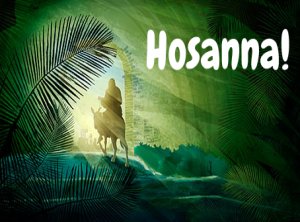
EmmDev 2020-04-06 [Perspective: God, Faith and Covid19] Hosanna...


Hosanna...

Those who went ahead and those who followed shouted,
"Hosanna! "
"Blessed is he who comes in the name of the Lord!"
"Blessed is the coming kingdom of our father David!"
"Hosanna in the highest!"      (Mark  11:9-10)

Yesterday was Palm Sunday.

I've been thinking about the word "Hosanna!"
If one looks at how "Hosanna" is used in many hymns and worship songs, one is left with the impression that it is a word that one sings out in praise and adoration - like "Hallelujah!" or "Glory!"

But this word is used in a very different way in the Old Testament:
  • It's a cry for help and deliverance of cities under attack from an enemy. (Joshua 10:6)
  • It's the cry of a widow to the king when she's lost one son and is about to lose another. (2Sam 14:4)
  • It's the cry of a widow to the king when a siege of Jerusalem forces them into cannibalism (2Ki 6:26)
Then we have a number of Psalms:
  • "Hosanna us, LORD! There is not a good person left;
    honest people can no longer be found." (Psa 12:1)
  • "O LORD, Hosanna the king! Answer us when we call!" (Psa 20:9)
  • "Hosanna your people and bless your inheritance;
    be their shepherd and carry them forever." (Psa 28:9)
  • "Hosanna us by your might; answer our prayer,
    so that the people you love may be rescued." (Psa 60:5)
  • "Turn to me and have mercy on me;
    grant your strength to your servant
    and Hosanna the son of your maidservant." (Psa 86:16)
  • "Hosanna us by your might; answer my prayer,
    so that the people you love may be rescued." (Psa 108:6)
  • "O LORD, Hosanna us; O LORD, grant us success." (Psa 118:25)
     
The other clue we must notice is the crowd's identification of Jesus as the "Son of David." This reveals a Messianic expectation. The crowd is longing for God's deliverance and rescue through the Messiah. They believed that Jesus was the Saviour-Messiah. In the case of the very first Palm Sunday, the crowds thought of a political Saviour-Messiah who would conquer the Romans and free Israel. But He came to do so much more! We know He conquered sin, death, and Satan. And so He can help us.

Yes, Hosanna is a cry of a heart in desperate need, but it has also become an expression of praise because we know that God can save and that He did and does save...

Hosanna! And Glory Hallelujah!


Thursday, April 2, 2020

EmmDev 2020-04-02 [Perspective: God, Faith and Covid19] Dislocation Guaranteed


Dislocation Guaranteed

Today I conducted a funeral in a newly planted congregation I am looking after. The rules of our South African lockdown meant that usual cultural burial customs couldn't be observed: nightly prayer vigils couldn't be held, the body couldn't go to the house the night before, there couldn't be more than 50 people present and there couldn't be refreshments afterwards.

The lady, who had passed away after a long fight with cancer, was much beloved by her family and community and I could sense the loss, but also the profound sense of dislocation when the familiar rituals of grief and parting had to be adapted for our new circumstances.

I reflected on this as I was driving home. This is the first of many changes coming our way in the wake of this pandemic... Gatherings, handshakes, travelling, the economy, the level of neglect we've tolerated for the poor and many other things are going to be changed during and after our battle with this virus.

The first and obvious thought is "Well thank goodness God doesn't change!"
And this is absolutely true and wonderfully comforting.
But there is the other side of the coin...

Change and dislocation will be a reality for many who follow Christ.

Put on your film-director's cap and picture the scene with me:
- Jesus has risen from the dead.
- He's helped the disciples catch another load of fish.
- They've had grilled fish on the beach.
- He invites Peter to take a walk on the beach.
- Peter is able to make a three-fold declaration of his loyalty.
(Cue the violins and sunset pastels)
Because surely this is the happy ending?

(Pause, rewind, and cue the mysterious edgy music and storm-clouds on the horizon.) But Jesus doesn't promise Peter moonshine and roses. He promises Peter not only discomfort and danger, but severe dislocation and the reality of things being the opposite of what he would have liked.

It's a very graphic picture: being dressed and led where he did not want to go. It's a picture of change and the loss of "normality." Jesus warned Peter that it would come. And for us as Christians world-wide it has come.

The comforting news is that Jesus knows about it.
He too has been where He didn't want to go.
But He chose to go to arrest, trial, crucifixion and death.
This is what Easter is about. 


For Christ-followers dislocation should not surprise or shock us.
It was promised to Peter and comes to us.
But the One who warned us it was coming will also be there to help us.

We only have to ask.

I tell you the truth, when you were younger you dressed yourself and went where you wanted; but when you are old you will stretch out your hands, and someone else will dress you and lead you where you do not want to go." Jesus said this to indicate the kind of death by which Peter would glorify God. Then he said to him, "Follow me!"
      (John21:18-19)


Wednesday, April 1, 2020

EmmDev 2020-04-01 [Perspective: God, Faith and Covid19] Leveraging the Moment


Leveraging the Moment

Paul was imprisoned twice in Rome. The first time he was somewhat of a celebrity prisoner in that he was arrested in Jerusalem and was about to be left to the mercy of the Jewish Courts when he asserted his rights as a Roman Citizen and appealed to Caesar. This meant that he was escorted to Rome and there was placed under house arrest for about two years.

During this time Paul was allowed to receive visitors, he mentored church leaders, shared his faith with his guards, discipled a young convert named Onesimus and wrote letters to the churches in Colosse, Ephesus and Philippi. He also wrote to a man named Philemon about his former slave Onesimus. I think it is safe to say that he leveraged his time, that he grew when he could have shrunk.

All over the world Christians find themselves "locked-down" or "socially-distanced". This puts us in a place of restriction, limitation, isolation and frustration.

What I love about Paul is how positively he used his time. He's under house arrest, his future in uncertain and while he has friends, he also has enemies. Yet in his letter to the church in Philippi he conveys a "bounciness" (joy) and optimism (faith) that catches one by surprise.

The passage below comes from the first chapter of the letter to the Philippians and from it we can glean a couple of important facets to Paul's "lockdown mentality".
  1. Paul took time pray deeply, thoughtfully and purposefully for the Philippians and others (we have detailed prayers he prayed for Colosse, Ephesus and Philemon too.)

  2. Paul didn't concentrate on his predicament, but about what his predicament could produce. He shared his faith with each soldier that guarded him and it seems that his faith-sharing was winsome and attractive, because he became known throughout Caesar's Palace as someone in chains for Christ.

  3. Paul looks for the positive in his circumstances. Instead of bemoaning what he couldn't do, he was excited about those who could be empowered. Instead of being a "victim" endangered by people preaching maliciously to stir up trouble, Paul is overjoyed that the gospel is preached. This is a remarkable quality. It is very easy to focus on the negatives. Paul refuses to do this.

  4. Paul makes a decision to "rejoice" and "continue to rejoice". (The Greek in the second verb is in the future tense and passive voice.) The passive voice conveys the sense that joy is a state-of-mind rather than an up-and-down emotion. His attitude and mindset is shaped by his hope and confidence in God. His joy is not a fleeting emotion - it is a deliberate decision. (The passive voice also is a way of showing that God is at work, helping Paul to keep rejoicing.)

  5. Paul believed that the prayers people prayed for him made a difference. We find a similar thought in 2 Corinthians where Paul noted that they "helped him by their prayers."

  6. Paul trusted that God's Holy Spirit was able to "help" (supply and support) him. (Paul is using the same word here as when he talks about every "supporting ligament" in the body of Christ.

  7. Paul trusted God for his future - whether that meant life or death. It's clear that Paul had asked the question: "What's the worst that could happen?" The worst that could happen was that he died, and he knew that even death was an empty threat. His trust in God was complete. Yes trouble, imprisonment and even death could come. But he trusted God.
These are the powerful qualities and attributes in Paul that leveraged his time of lockdown.
- How can we grow and not shrink in these circumstances?

- How can we be a witness?
- Who can we pray for?
- What are the "letters" we could write?
- How can we choose our attitudes and deepen our faith?

Read the passage below and review Paul's qualities above and spend some time making decisions about how you'll handle this challenging time.

Leverage the moment!

And this is my prayer: that your love may abound more and more in knowledge and depth of insight,  so that you may be able to discern what is best and may be pure and blameless until the day of Christ,  filled with the fruit of righteousness that comes through Jesus Christ--to the glory and praise of God.

Now I want you to know, brothers, that what has happened to me has really served to advance the gospel.  As a result, it has become clear throughout the whole palace guard and to everyone else that I am in chains for Christ.  Because of my chains, most of the brothers in the Lord have been encouraged to speak the word of God more courageously and fearlessly.

It is true that some preach Christ out of envy and rivalry, but others out of goodwill.  The latter do so in love, knowing that I am put here for the defense of the gospel.  The former preach Christ out of selfish ambition, not sincerely, supposing that they can stir up trouble for me while I am in chains.  But what does it matter? The important thing is that in every way, whether from false motives or true, Christ is preached. And because of this I rejoice.

Yes, and I will continue to rejoice,  for I know that through your prayers and the help given by the Spirit of Jesus Christ, what has happened to me will turn out for my deliverance.  I eagerly expect and hope that I will in no way be ashamed, but will have sufficient courage so that now as always Christ will be exalted in my body, whether by life or by death.  For to me, to live is Christ and to die is gain.      (Philippians1:9-21)